 LaunchAutomationNews from
n8n launches Agents that work out their own steps and use workflows as tools
On September 25, 2026, n8n added Agents: you describe a goal, pick a model and tools, and the agent plans the steps. Each agent turn counts as one execution.
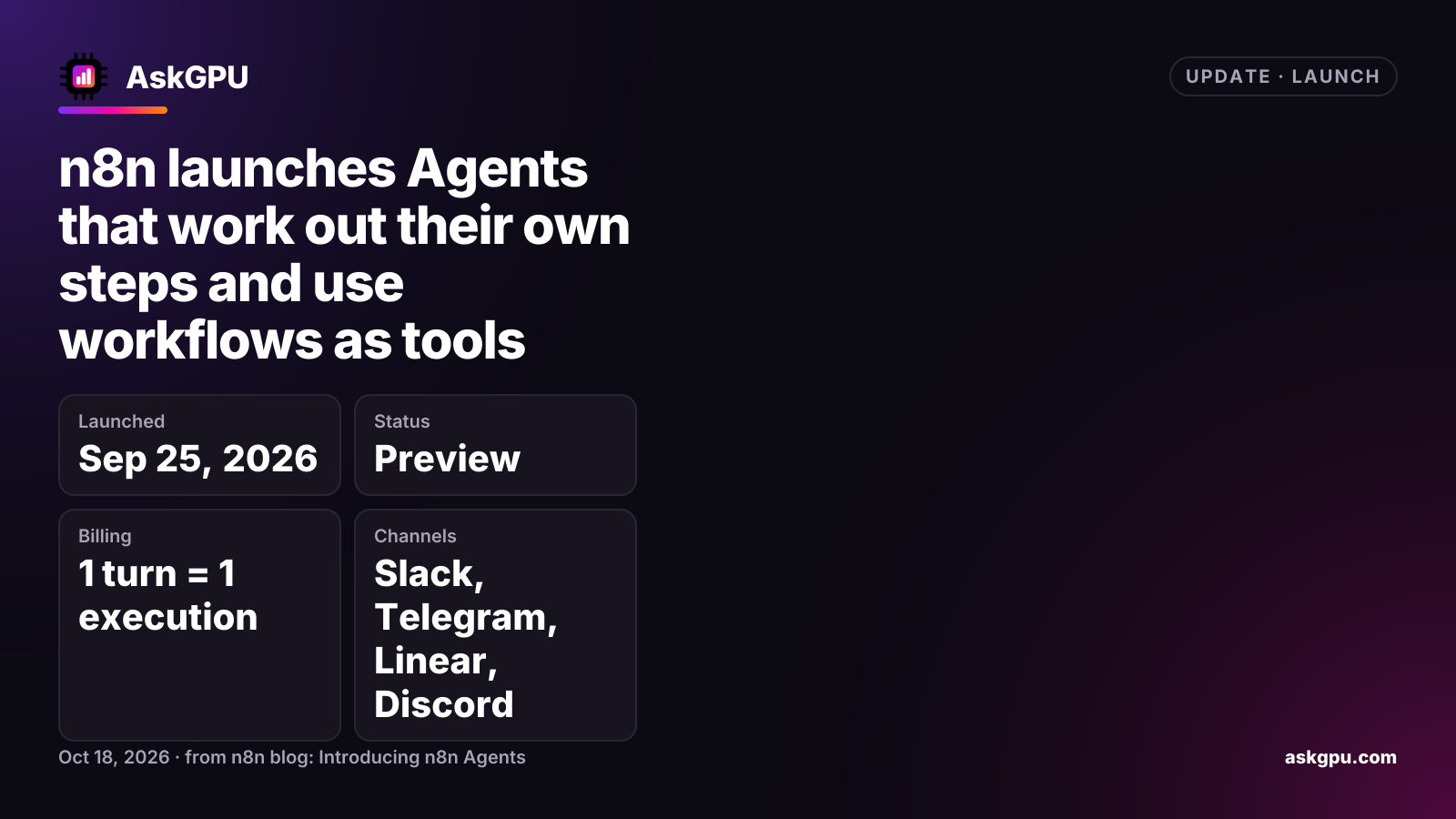
n8n introduced Agents on September 25, 2026. An agent is a new kind of building block that sits next to n8n’s workflows: you describe what it should do, choose a model and the tools it may use, and it works out the steps itself. n8n says the feature is still in preview and will improve release by release.
What an agent includes
Until now, building an agent in n8n meant wiring together a chat trigger, a memory node and an AI Agent node inside a workflow. Agents come with those parts built in. Each one has:
- a model, from any provider you have credentials for or through n8n’s Gateway credits
- plain-language instructions
- channels and triggers: Slack, Telegram, Linear, Discord or a schedule
- tools: n8n integrations, MCP servers and your existing workflows
- skills, sub-agents, memory and stored sessions you can review step by step
Knowledge files (CSV, PDF, Markdown or text) are available on n8n Cloud. You can mark a tool as sensitive so the agent stops for an Approve or Reject before using it. A new Message an Agent node lets a normal workflow call an agent as one of its steps. The existing AI Agent node is unchanged.
How it is billed
The post gives no prices. It says one turn with an agent counts as one execution, and that tool calls to workflows and sub-agents are not counted separately. Agents share the same execution quota as workflows. Building an agent with n8n Assistant uses AI credits, and model calls through Gateway credits are paid from that balance.
Where it runs
Agents are available to everyone on n8n Cloud on the latest stable version. Self-hosted Community Edition users can run them with some extra setup. For Enterprise, agents are in preview, with more governance features to come.
Why it matters
Agents draw on the same execution quota as workflows, and a turn that calls workflows or sub-agents as tools still counts as one execution. That differs from Zapier’s AI steps, where each tool call adds tasks. Model costs come on top, through your own API key or Gateway credits.
What to do
If you already run agents built from AI Agent nodes, they keep working, so there is no rush to move. For new back-and-forth jobs, such as answering team questions in Slack, try an agent on a test instance and watch how many executions and model tokens a typical conversation uses before you rely on it.
Sources
Read on . Prices are in US dollars. How we check facts